Building a powerful Shopify app is only half the battle. In a marketplace teeming with thousands of solutions, even the most innovative app can go unnoticed without a strategic marketing plan. Many developers focus intensely on code and features, only to find themselves struggling for visibility and adoption after launch. Success isn't just about being listed in the Shopify App Store; it's about connecting with the right merchants, demonstrating value, and fostering long-term growth. A "build it and they will come" approach is a recipe for obscurity.
Why an "Ultimate Guide"? Navigating the Shopify App Landscape
The Shopify app market is dynamic and highly competitive. Merchants are inundated with choices, and capturing their attention requires a multifaceted strategy that extends far beyond a simple app listing. This guide provides a complete framework from start to finish, moving beyond separate tactics to combine promotion, conversion, retention, and scaling into one clear strategy. It's designed to cut through the noise and offer a clear blueprint for sustainable success in app marketing.
The Three Pillars of App Growth: Promote, Grow, Scale
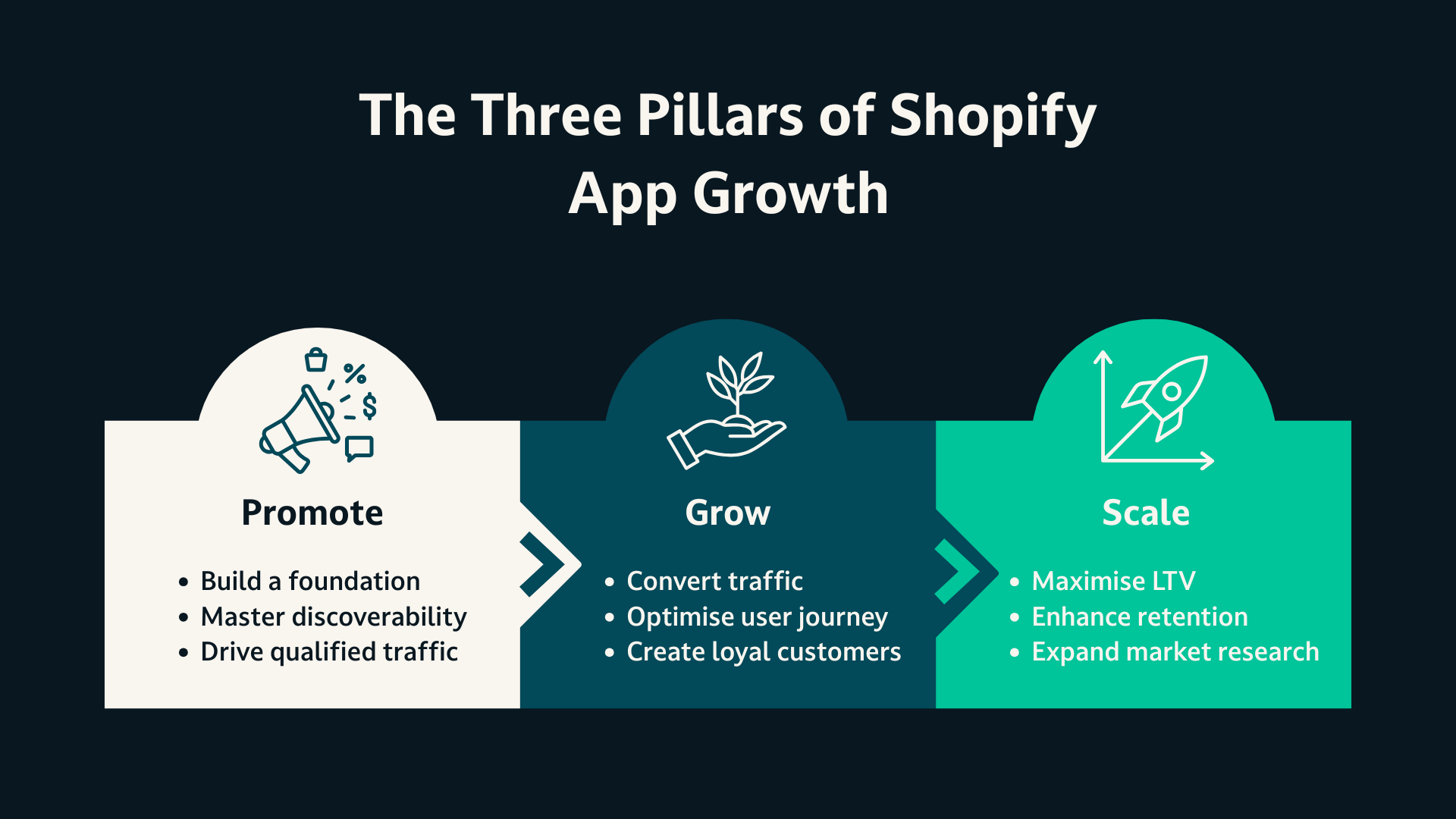
The App Growth framework provides a structured approach, starting with a solid foundation before moving through the three core pillars of promotion, growth, and scaling.
Our approach is built on three core pillars that mirror the lifecycle of a successful app:
-
Promote: This initial phase focuses on building a strong foundation, mastering discoverability, and driving qualified traffic to your app.
-
Grow: The second pillar centres on converting that traffic into loyal, paying customers by optimising the entire user journey.
-
Scale: Finally, this phase involves maximising customer lifetime value, enhancing retention, and strategically expanding your market reach.
This structured framework ensures you're not just acquiring users, but building a thriving, sustainable business.
Who This Guide Is For: Empowering Shopify App Developers
This guide is for Shopify app developers, marketers, and product managers at every stage of their journey. Whether you are preparing for your first launch, looking to increase installs for an existing app, or aiming to grow your user base into a category leader, the principles and strategies here will give you clear direction to dominate the market. Every app developer can find actionable value within this framework.
Pillar 1: Laying the Foundation – Building an App Designed for Marketing Success
Before a single marketing campaign is launched, your app must be built on a solid foundation. This foundational work ensures that your marketing efforts are targeting the right audience with the right message, maximising your return on investment from the very beginning.
Understanding Your Target Merchant Persona
Your primary customer is the Shopify merchant, but "merchant" is not a monolith. To market effectively, you must understand their world. What are their biggest pain points? Are they a dropshipper struggling with fulfilment, a brick-and-mortar store expanding online with Shopify POS, or an enterprise-level brand on Shopify Plus?
Creating detailed merchant personas is crucial. Research their challenges by:
-
Engaging in the Shopify Community: Observe the questions merchants ask and the problems they're trying to solve. This is a goldmine for understanding their real-world needs.
-
Analysing Competitor Reviews: Scour the product reviews of similar apps. Note what merchants love (features to highlight) and what they hate (opportunities for you to excel).
-
Interviewing Existing Customers: If you have them, talk to them directly about their business goals, daily workflows, and the specific outcomes they hope to achieve with your app.
This deep understanding informs every subsequent marketing decision, from the features you prioritise to the copy on your App Listing.
Developing a Compelling Value Proposition
With a clear persona in mind, you can craft a powerful value proposition. This is a concise statement that answers the question: "Why should a merchant install your app over any other?" It should clearly articulate the primary benefit, differentiate you from competitors, and speak directly to the merchant's needs. Your value proposition is the cornerstone of your App Listing, website, and all promotional campaigns. A great value proposition isn't about listing features; it's about promising an outcome (e.g., "Save 10 hours a week on inventory management" is better than "Advanced inventory syncing").
Strategic Pricing for Growth and Monetisation
Pricing is a critical marketing tool. Your pricing plans must align with the value your app provides and the financial capacity of your target merchant. Consider models like:
-
Tier-Based Pricing: Offer different feature sets at various price points to cater to merchants of different sizes, from startups to enterprise clients.
-
Usage-Based Billing: Charge based on volume, such as the number of orders processed or emails sent. This model scales with the merchant's success.
-
Volume Discounts: Incentivise larger merchants or higher usage with reduced rates, making your app more attractive for high-growth stores.
A well-structured free plan acts as a powerful acquisition tool, allowing merchants to experience your app's core value before committing to a paid plan, thereby boosting your overall conversion rate. Ensure the free plan provides genuine value but clearly illustrates the benefits of upgrading.
The Technical & User Experience Checklist
A seamless user experience is non-negotiable. Your app must be easy to install, intuitive to navigate, and integrate flawlessly with the Shopify Admin. A buggy or confusing app will lead to negative product reviews and high churn, undermining even the best marketing efforts. Before you promote, ensure:
-
Flawless Installation: The process is one-click and straightforward, with clear permissions.
-
Intuitive Onboarding: A clear, guided setup process helps merchants achieve their first "win" quickly, demonstrating value immediately.
-
Deep Integration: Your app feels like a native part of the Shopify store environment, not a bolted-on third-party tool.
-
Speed and Reliability: Performance issues are a primary driver of uninstalls. According to Google, a 1-second delay in mobile load times can impact conversion rates by up to 20%.
Pillar 2: Promote – Driving Qualified Traffic to Your Shopify App
With a strong foundation in place, the next step is to drive targeted traffic to your app. This pillar focuses on making your app discoverable and actively reaching out to potential customers where they are most active.
Mastering Shopify App Store Optimisation (ASO)
The Shopify App Store is the primary discovery channel for most merchants. ASO is the process of optimising your listing to rank higher in search results and attract more clicks. This involves:
-
Strategic Keyword Research: Use tools like Google Keyword Planner to identify the terms merchants use to search for solutions like yours. Focus on both high-volume terms and long-tail keywords that indicate strong intent.
-
A Compelling App Listing: Your title and subtitle should include your primary keyword and clearly state your app's function. The description must use your value proposition to sell the benefits, not just list features.
-
High-Quality Visuals: A professional app icon is your first impression. Use clear screenshots and short Video Tutorials to demonstrate your app in action and show how it fits into a merchant's workflow.
-
Encourage Product Reviews: Positive reviews are one of the most significant ranking factors and trust signals. Prompt satisfied users at the right time to leave honest feedback.
External Marketing: Building Your App's Brand Beyond the Store
While ASO is crucial, you must also build a presence outside the App Store to capture merchants who aren't actively searching.
-
Content Marketing: Create blog posts, guides, and case studies that address your target merchant's pain points, positioning your app as the solution. This builds authority and drives long-term Organic Traffic.
-
Performance Marketing: Run targeted Google Ads campaigns that direct merchants to your app's dedicated landing page or its listing in the Shopify App Store. Utilise automated strategies like Target ROAS (Return On Ad Spend) to optimise for installs and revenue. Install a Facebook Pixel to build retargeting audiences for social media posts.
-
Email Marketing & SMS Marketing: Build an email or SMS subscriber list through a newsletter signup on your website. Nurture these leads with valuable content, promotional announcements, and special offers. Direct channels like email marketing and SMS marketing are crucial for building relationships and driving conversions.
Pillar 3: Grow – Converting Visitors into Loyal Customers
Driving traffic is only the first step. The next critical phase is converting those visitors into active, paying users. This pillar focuses on optimising the entire journey from discovery to loyal customer.
Optimising the App Store for the Onboarding Journey
The transition from the Shopify App Store to using your app must be seamless. Once a merchant installs your app, the onboarding process should immediately reinforce the value promised in your listing. A clunky or confusing onboarding experience is a major point of user drop-off. Guide the user through the initial setup with clear instructions and tooltips, helping them achieve a meaningful outcome within the first session.
Conversion Rate Optimisation (CRO) for Your App Listing and Website
Continuously test and refine your marketing assets to improve your conversion rate. For your Shopify App Listing and any external landing page, this means A/B testing elements like:
-
Headlines and subheadings
-
Screenshots and video thumbnails
-
Call-to-action (CTA) button text and colour
-
Social proof placement
Even small improvements in conversion can have a significant impact on the number of new users you acquire from your marketing campaigns. Use tools that offer Visitor Replays to understand where users are dropping off in the funnel.
Building Trust and Credibility
Merchants are entrusting a part of their business to your app. Building trust is paramount. The most powerful way to do this is through social proof. Actively encourage satisfied users to leave honest product reviews on the Shopify App Store. To further solidify your credibility, show testimonials, case studies, and partner logos on your website. This will reassure potential customers that they are making a safe choice. A clear developer's privacy policy is also a critical trust signal.
Leveraging Shopify Features for Conversion
Integrate your app deeply within the Shopify ecosystem to create a frictionless experience. Use Shopify's Polaris design system for a familiar UI that feels native within the Shopify Admin. Ensure your app works seamlessly with popular themes, Shopify Checkout, and other essential apps. By making your app feel like a natural extension of the Shopify store environment, you reduce friction and increase the likelihood of adoption and long-term use.
Pillar 4: Scale – Maximising Lifetime Value and Expanding Reach
Acquiring a customer is expensive; retaining them is where true profitability lies. This final pillar is about fostering loyalty, increasing revenue from your existing user base, and strategically expanding your market presence.
Enhancing Customer Engagement and Retention
Sustainable growth is built on retention, not just acquisition. Proactive customer engagement is key. Use email marketing and in-app notifications to share new features, offer tips, and gather feedback. Excellent customer support that is responsive and helpful - delivered through email or Live Chat Channels - turns users into advocates. Monitor churn rates closely using tools like Google Analytics and reach out to users who cancel to understand their reasons, turning that feedback into product improvements.
Strategic Upselling and Cross-Selling
As your users grow their business, their needs will evolve. Develop tiered pricing plans that allow them to upgrade as they require more advanced features. This creates a natural growth path within your app. If you have a portfolio of apps, look for opportunities for upsell/cross-sell offers that complement each other (e.g., promoting a bundle app to users of your volume discount app or creating Product Bundles). This strategy increases customer lifetime value (LTV) and further embeds your apps into the merchant's daily operations.
Expanding Your Market and Reach
Once you have a solid footing, explore new avenues for growth. Expand your footprint by localising your app for new languages and markets in the Regions you choose. You can create strong integrations with other popular Shopify apps to reach their users or form partnerships with agencies and influencers who serve the Shopify merchant community. Tailoring a solution or providing dedicated support for high-volume Shopify Plus merchants can also open up a lucrative new market segment.
Advanced Strategies and Sustainable Growth
To achieve category leadership, you must move beyond the basics and embrace advanced, data-driven strategies. This section covers the techniques that separate thriving app businesses from the rest.
Data-Driven Marketing: Analytics and Optimisation
Your marketing efforts should be guided by data, not guesswork. Use Google Analytics and your own app's database to track key metrics such as install sources, conversion rate from install to paid plan, customer lifetime value (LTV), and churn rate. This data helps you identify your most profitable marketing campaigns and channels, allowing you to continuously reallocate your budget and effort to what works best. User Journey Attribution models can help you understand which touchpoints contribute most to a conversion.
The Role of Automation and AI in App Marketing
Use marketing automation to grow your efforts efficiently. Set up automated email sequences using Shopify Flow or third-party tools for onboarding new users, nurturing leads from your landing page, and re-engaging inactive customers. Use AI-powered tools within Google Ads to optimise campaigns or chatbots to handle initial customer support queries. Automation frees up your time to focus on high-level strategy while ensuring consistent communication with your customers.
Building an Ethical and Trustworthy App Business
Trust is your most valuable asset. Be clear about your data policies, provide transparent pricing with no hidden fees, and always follow Shopify's Partner Program Agreement, especially when asking for product reviews. Using honest methods and having a clear privacy policy helps build a good brand reputation that leads to loyal customers and positive recommendations over time.
Staying Ahead: Evolving with the Shopify Ecosystem
The Shopify platform is constantly evolving, and your app and marketing strategy must evolve with it. Stay informed about new Shopify APIs, features like Shopify Forms, and policy changes. Join the Shopify developer community actively and listen closely to merchant feedback to predict future needs. The most successful apps are those that change and improve all the time, which is especially true when new chances come up with partners or in the Shopify Plus ecosystem.
Conclusion: Your Blueprint for Shopify App Marketing Dominance
Success in the Shopify app ecosystem is not an accident; it is the result of a deliberate, strategic, and sustained app marketing effort. By moving beyond a simple "launch and hope" mentality, you can build a powerful engine for growth that consistently attracts, converts, and retains the right merchants for your app.
Recap of the Strategic Framework: Promote, Grow, and Scale Your App
This guide has provided a comprehensive framework built on foundational preparation and three core pillars. It begins with laying the foundation—understanding your customer, defining your value, and perfecting your product. From there, you promote to drive discovery, grow by converting traffic into loyal users, and Scale by maximising lifetime value and expanding your reach. Each stage builds upon the last, creating a virtuous cycle of growth.
The Continuous Cycle of Optimisation and Innovation
This blueprint is not a one-time checklist but a continuous cycle. The insights you gain from collecting feedback and analysing data should constantly inform your product development and marketing campaigns. The Shopify market never stands still, and neither should your efforts. By always improving and creating new features, you can change your Shopify app from just another listing into a tool that thousands of merchants need, helping your business grow and succeed.
Need help scaling your Shopify store or app?
We're here to support your business growth. Take a look at our Shopify services here. or get in contact with us.
Build, grow, and scale on Shopify
Looking for a Shopify partner who actually understands eCommerce performance? We design and build stores that convert, optimise site speed, and integrate the right tools to scale your growth.
Whether you’re migrating to Shopify, replatforming from Magento, or levelling up your store design, we’ll help you make the move with confidence — and measurable results.